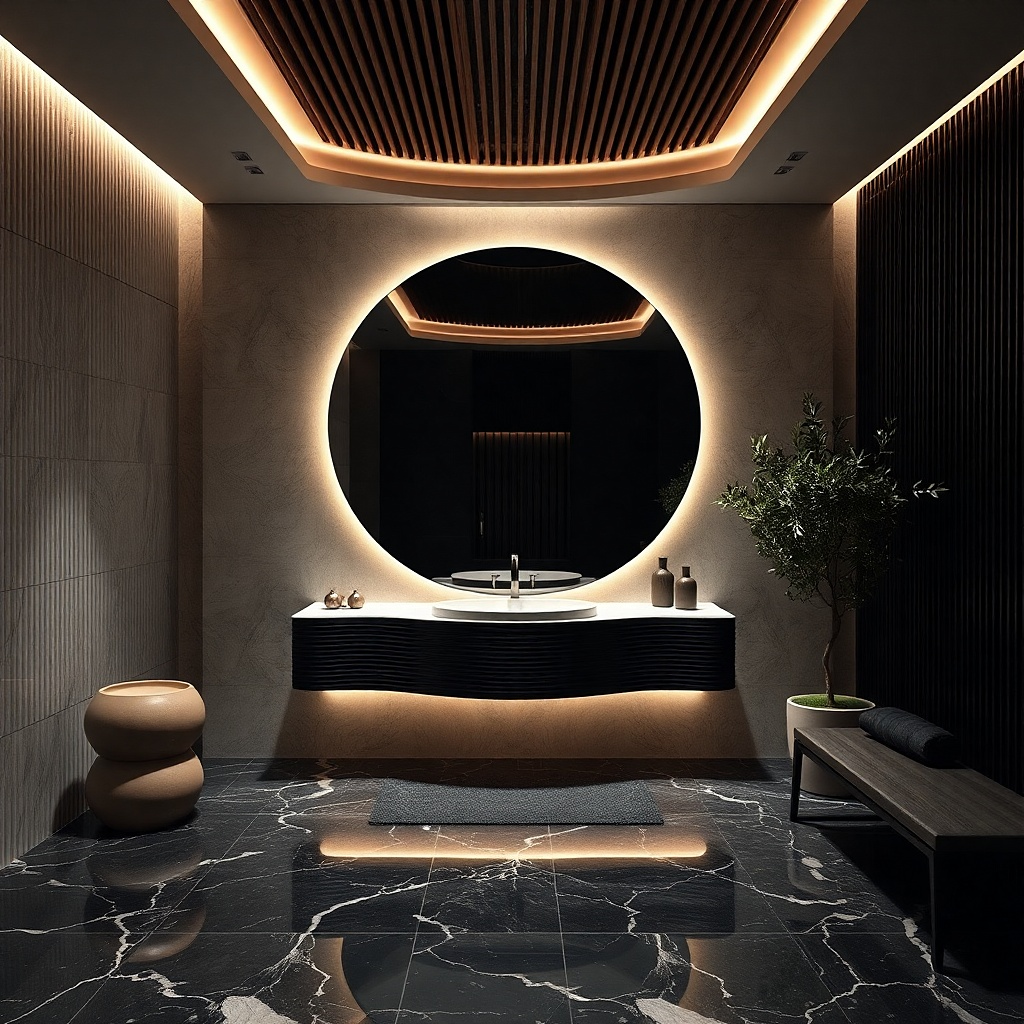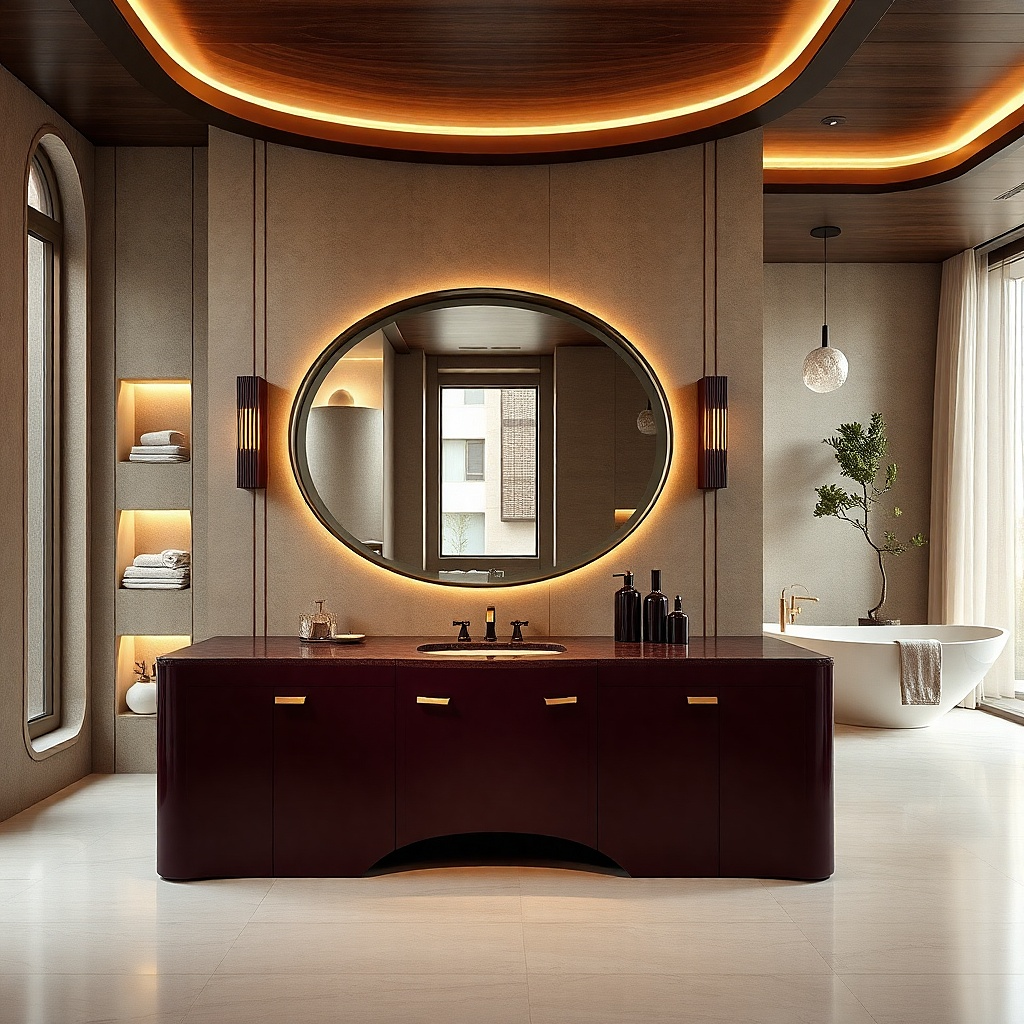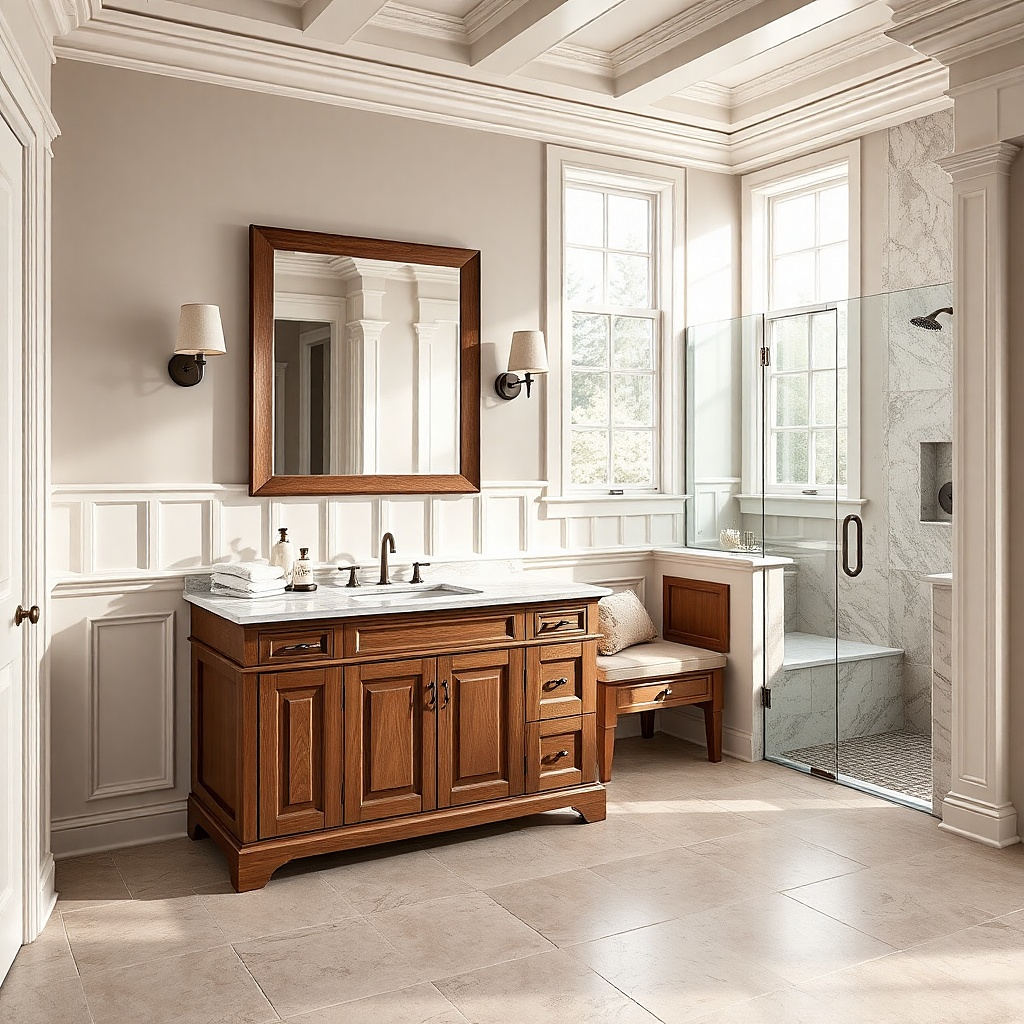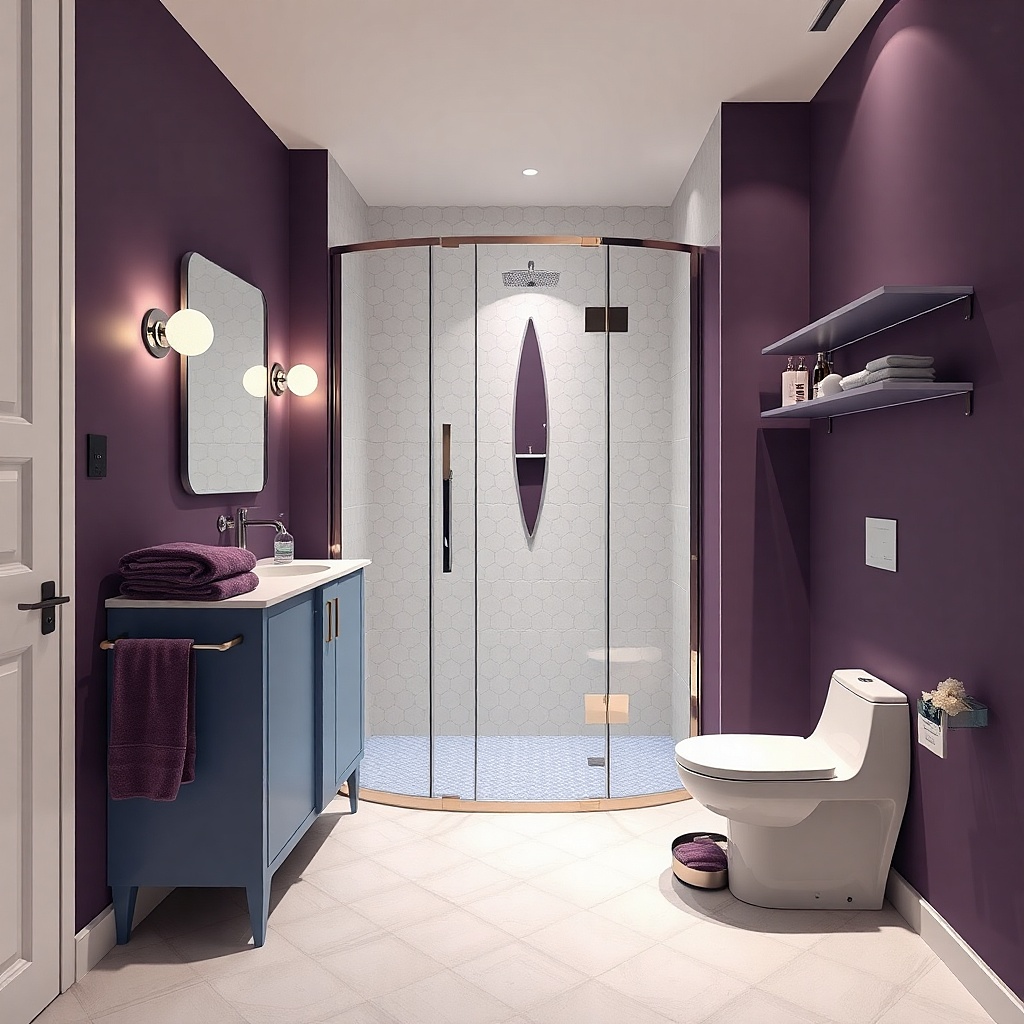
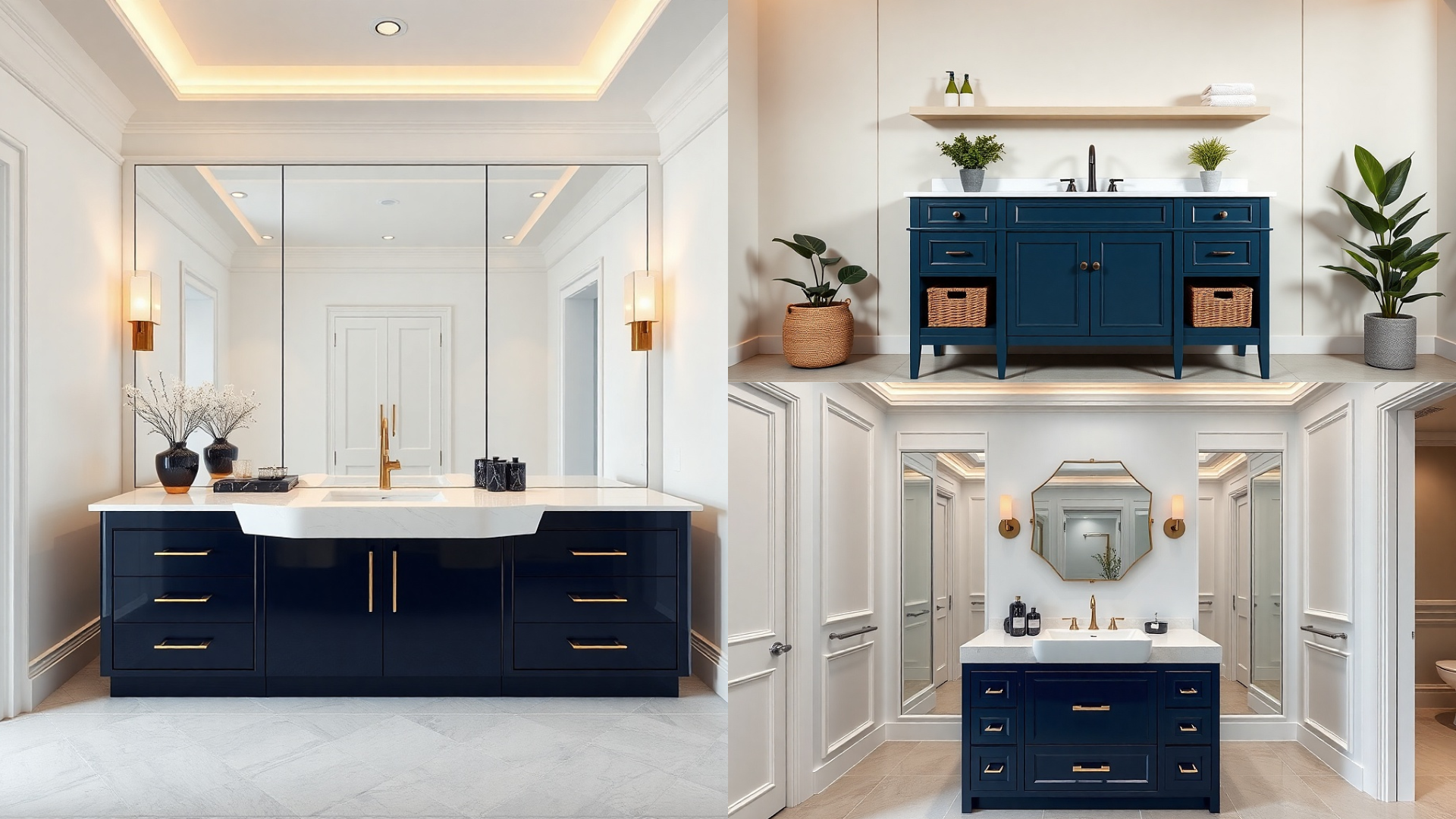
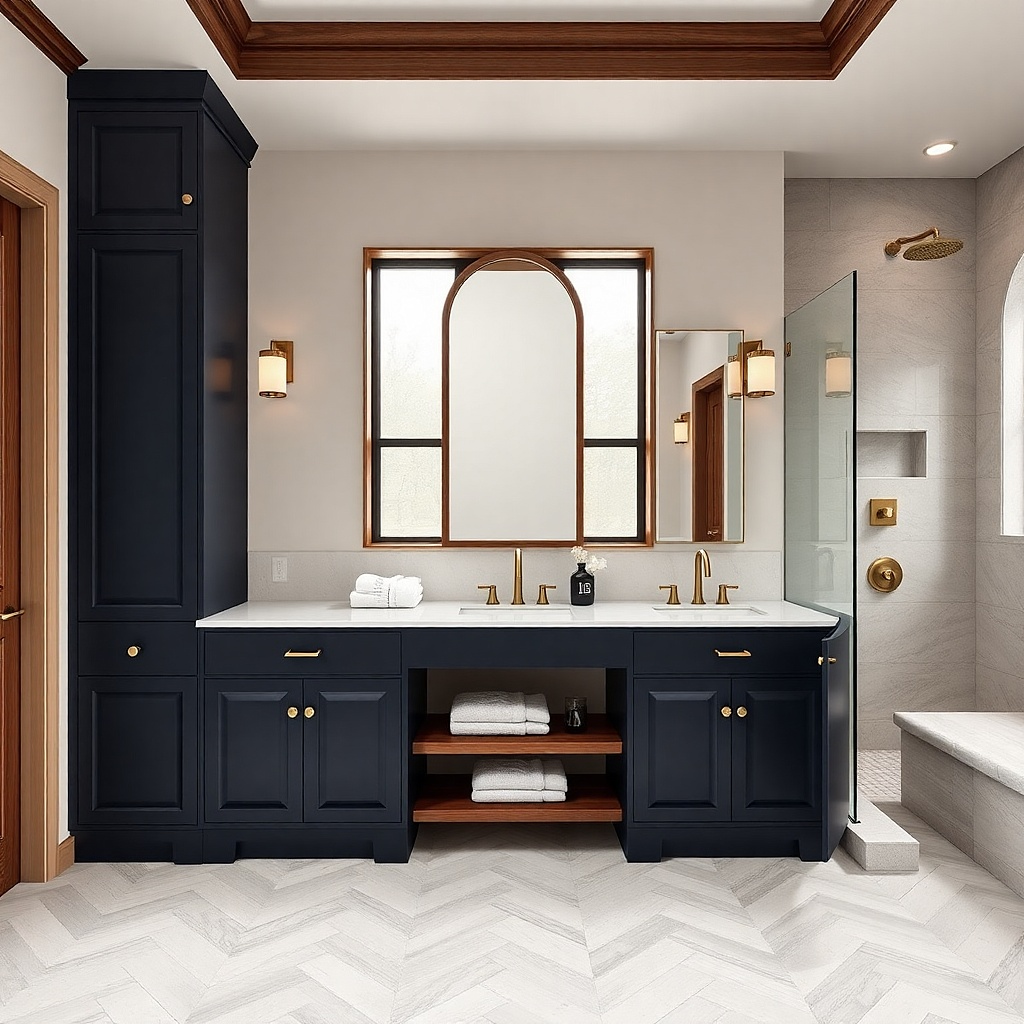
1. Matte navy shaker with white quartz and brushed nickel
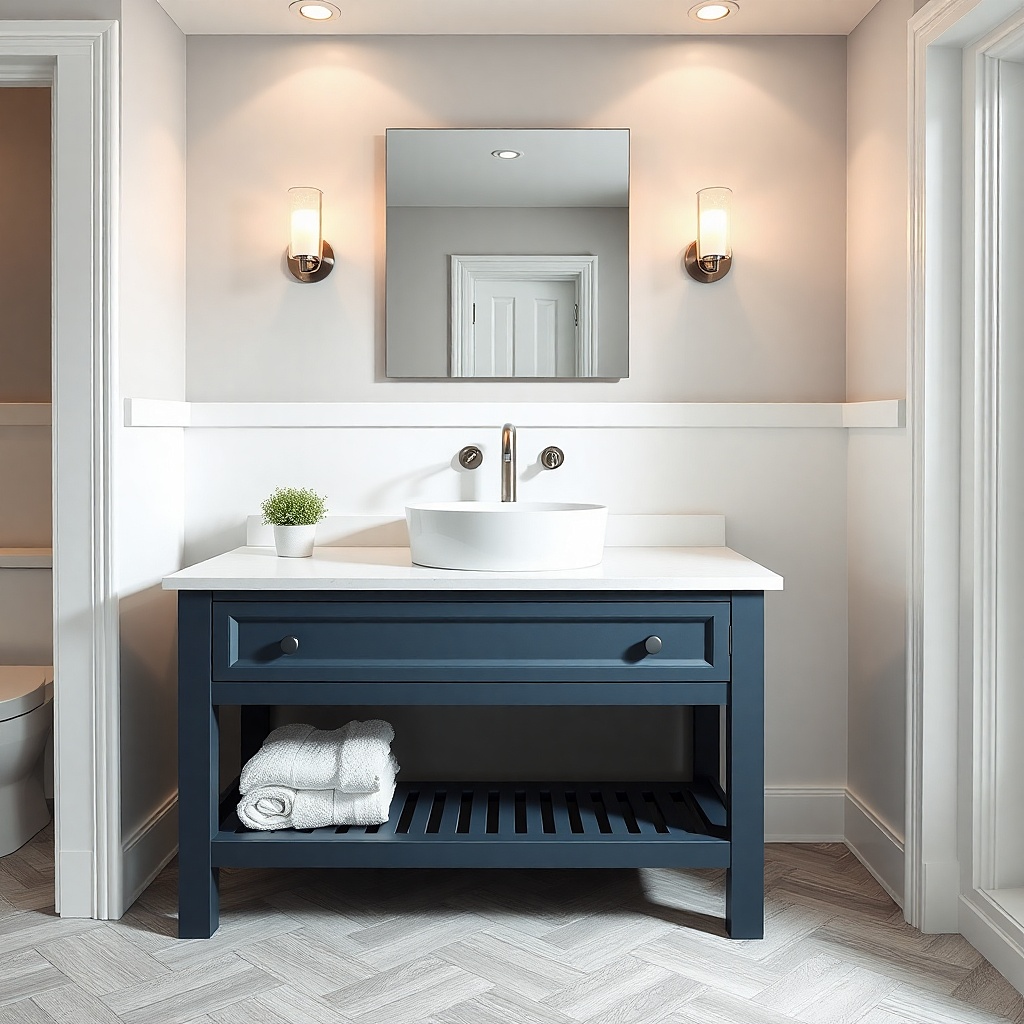
This is the “clean depth” option. Matte navy shaker doors create shadow lines in the recessed panels, so the face looks dimensional even when the paint is not glossy. Pair it with a bright white quartz top and a mirror that has a thin brushed nickel frame, and the vanity stops feeling like a flat block. Brushed nickel keeps the look modern and cool, which makes deep navy feel intentional rather than heavy. It’s a strong fit for small-to-mid bathrooms where you want structure, not drama.
Measure the vanity width against the wall and leave 2-3 inches of clearance on each side for a mirror. Choose a matte navy finish with a shaker door profile that has recessed rails and stiles, then install the hardware centered at the same height on every drawer. Use a white quartz top with minimal veining and a backsplash that matches the top’s thickness. Finally, mount a tall mirror with a thin brushed nickel edge so light bounces upward.
Keep the countertop edge simple and straight; busy edges make matte navy look cluttered.
Avoid mixing matte navy with very warm brass hardware in the same design — the face will look mismatched.
2. High-gloss navy lacquer with waterfall quartz edge
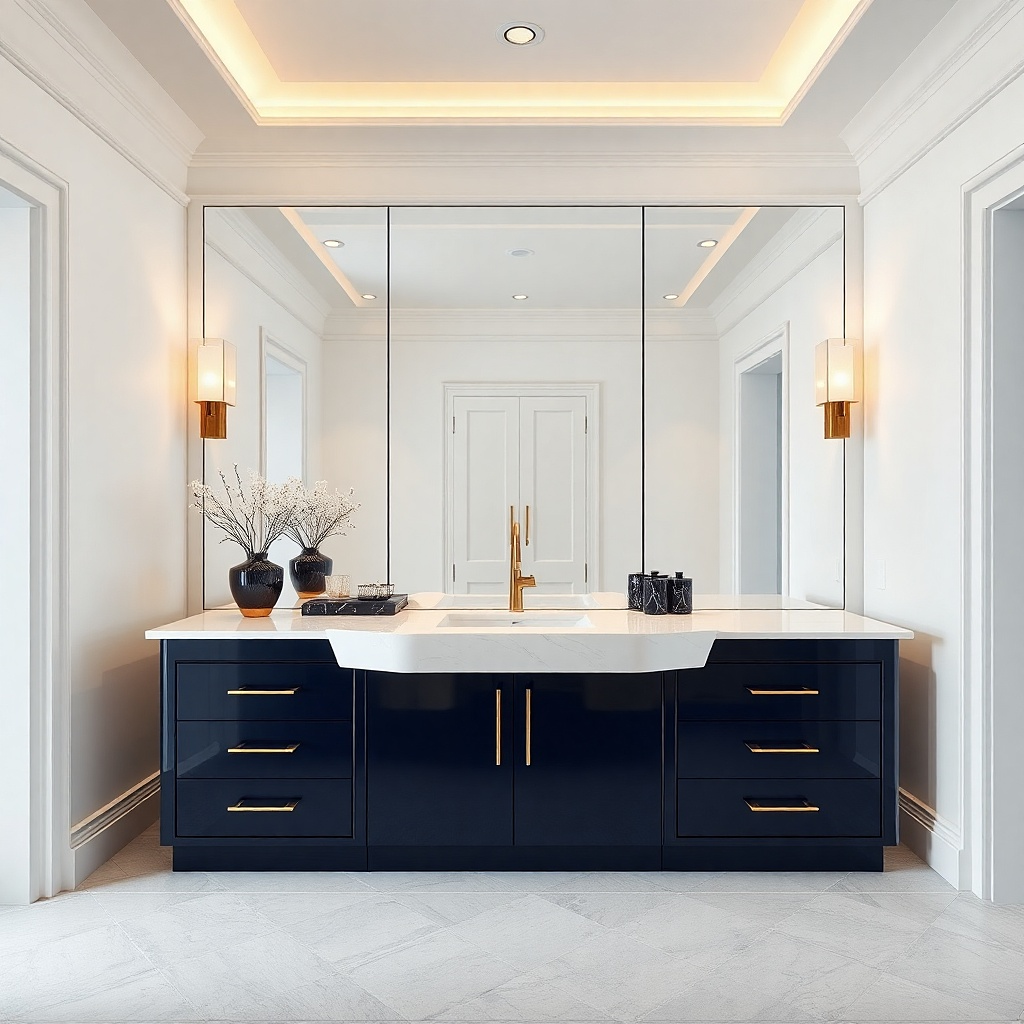
Glossy navy is the fastest way to manufacture depth. The reflective surface catches bathroom light and turns it into a visual gradient, so the vanity looks deeper than its actual dimensions. Go for a waterfall quartz edge in bright white or soft ivory to amplify the shine without adding clutter. Brass accents on the mirror frame and faucet add warmth to the glossy finish, which keeps the look elegant instead of cold. This setup looks especially good in bathrooms with strong lighting — vanity lights or a bright overhead fixture.
Pick a true lacquer-like finish (not a flat paint) and order a navy cabinet with sealed doors to reduce scuffs. Install a light quartz top with a waterfall edge so the material wraps down the front; aim for a 1.25-1.5 inch top thickness for a substantial look. Choose a single-hole or widespread faucet in unlacquered brass and keep the drain cover in the same finish. Mount the mirror so its bottom edge sits around 6-10 inches above the countertop for a tight, polished proportion.
Use a dimmable light over the vanity and set bulbs to a neutral 3500K-4000K so the gloss reads smooth, not blue.
Skip dark marble tops with glossy navy if your bathroom has low light — both together can feel heavy.
3. Navy raised-panel vanity with gold-toned hardware
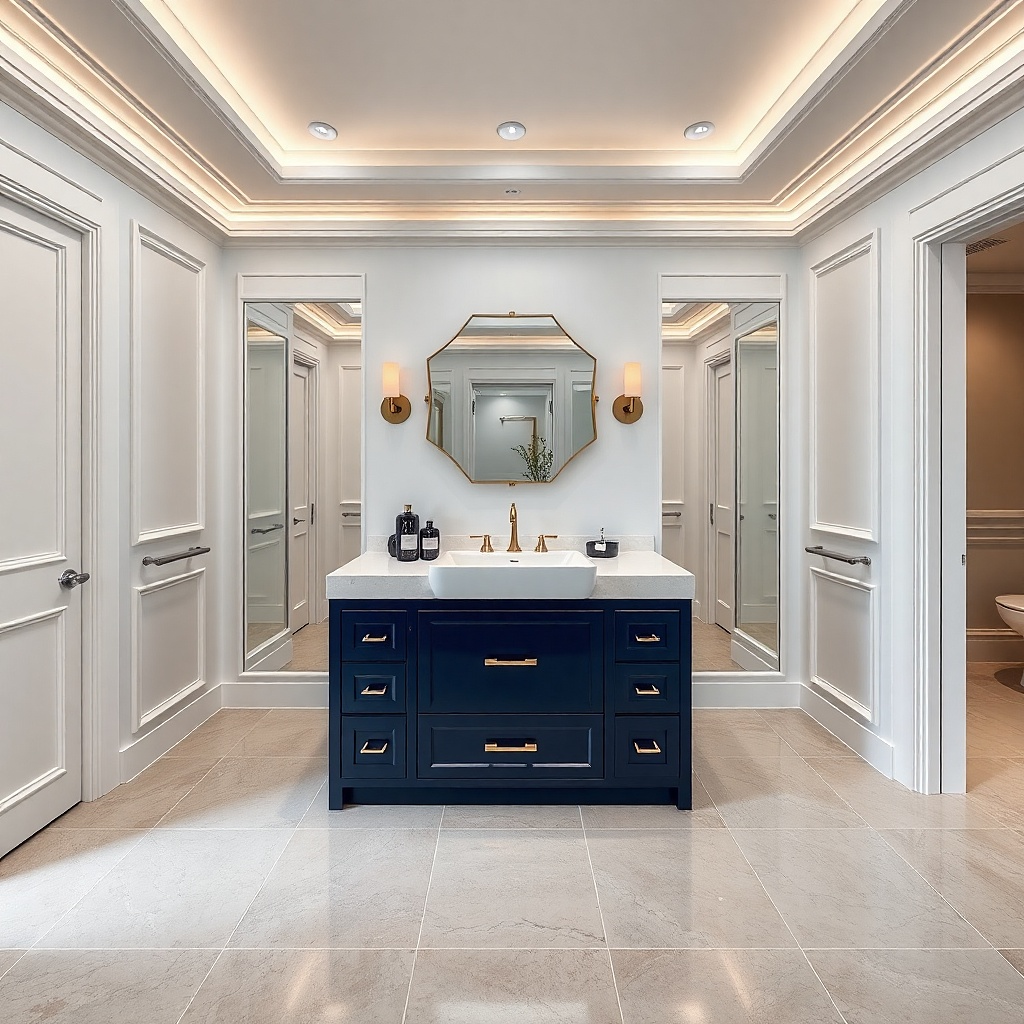
Raised-panel doors create depth through real shadowing. When the navy paint is a deep, even tone, the panel edges cast fine lines that look premium under everyday lighting. Warm gold hardware knobs and pulls makes the navy feel richer and more formal, especially with a creamy white countertop that has soft beige undertones. Add a framed mirror in a similar warm metal to pull the whole face together. This is a great choice when you want traditional elegance but still want the bathroom to feel fresh.
Try thisUse knobs on drawers and pulls on doors if the vanity allows it it adds a subtle rhythm to the front.
Choose a vanity with true raised-panel construction, not just a flat door with lines. Select a navy paint that reads deep and uniform; avoid navy that looks patchy or too gray. Pair it with a countertop in warm white quartz or a light solid surface, and keep the backsplash minimal so the door relief stays the star. Install hardware with consistent spacing and align pulls across all drawers so the door relief looks crisp.
Common mistakeDon’t go with very small hardware on raised panels; tiny knobs disappear and flatten the door detail.
4. Navy floating vanity with slim legs and light gray tile floors
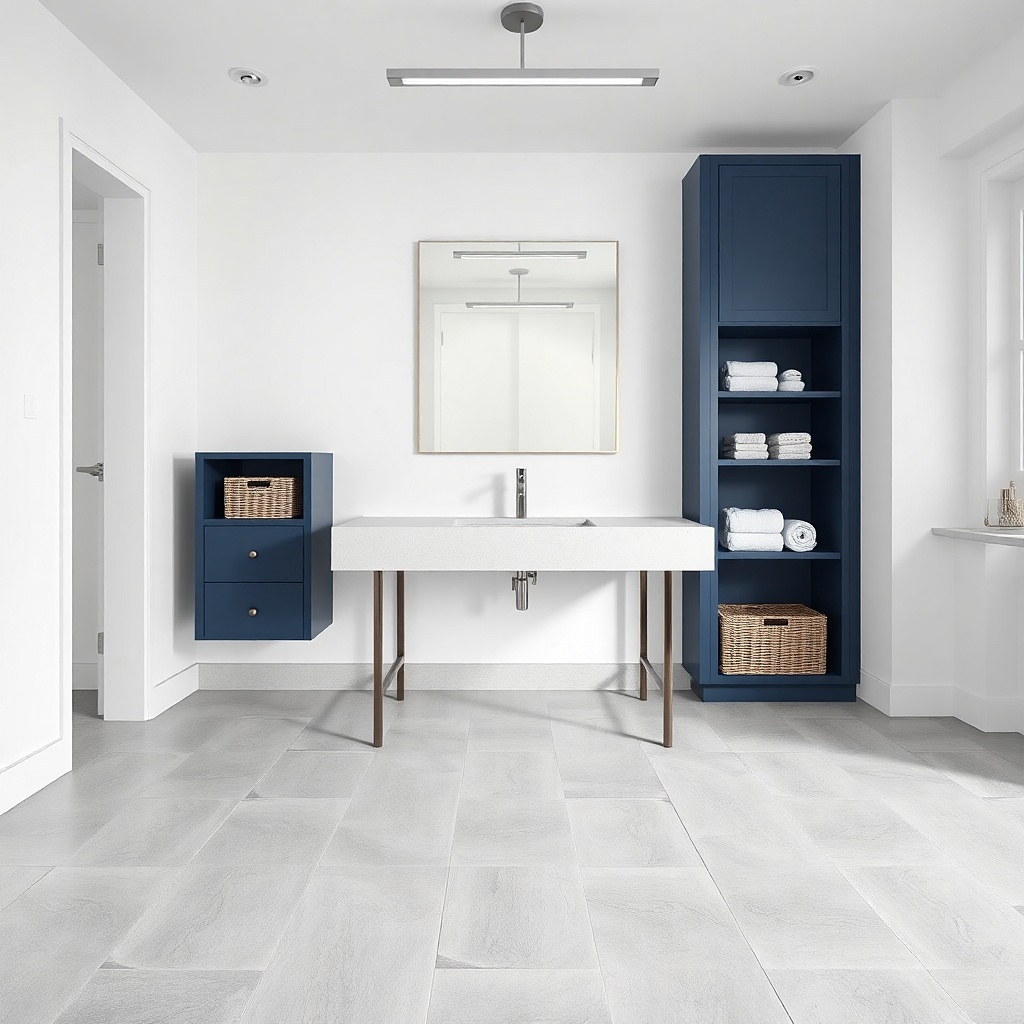
A floating navy vanity is the best way to get depth without visual bulk. When the cabinet sits off the floor (or uses very slim legs), the bathroom keeps breathing room, so the navy reads as a design feature instead of weight. The light top and clean mirror keep the contrast high, while the floating install adds a modern, airy line. This works well in bathrooms with light gray tile floors because the grout lines and the navy tone create a controlled, layered look. It’s also practical for easier floor cleaning.
Try thisKeep the cabinet face free of decorative molding so the floating line stays crisp.
Pick a vanity that mounts to wall studs or uses a secure cleat system; confirm the bracket spacing before purchase. Choose a slim floating or leg style with a straight front and minimal toe-kick. Install it so the countertop height lands around 32-34 inches to match common bathroom comfort standards. Finish the look with a bright quartz top and a mirror that is taller than the vanity, ideally centered on the sink.
Common mistakeAvoid pairing a floating navy vanity with a wide, heavy base cabinet on the same wall — it fights the airy effect.
5. Two-tone navy vanity with darker base drawers and lighter upper cabinet
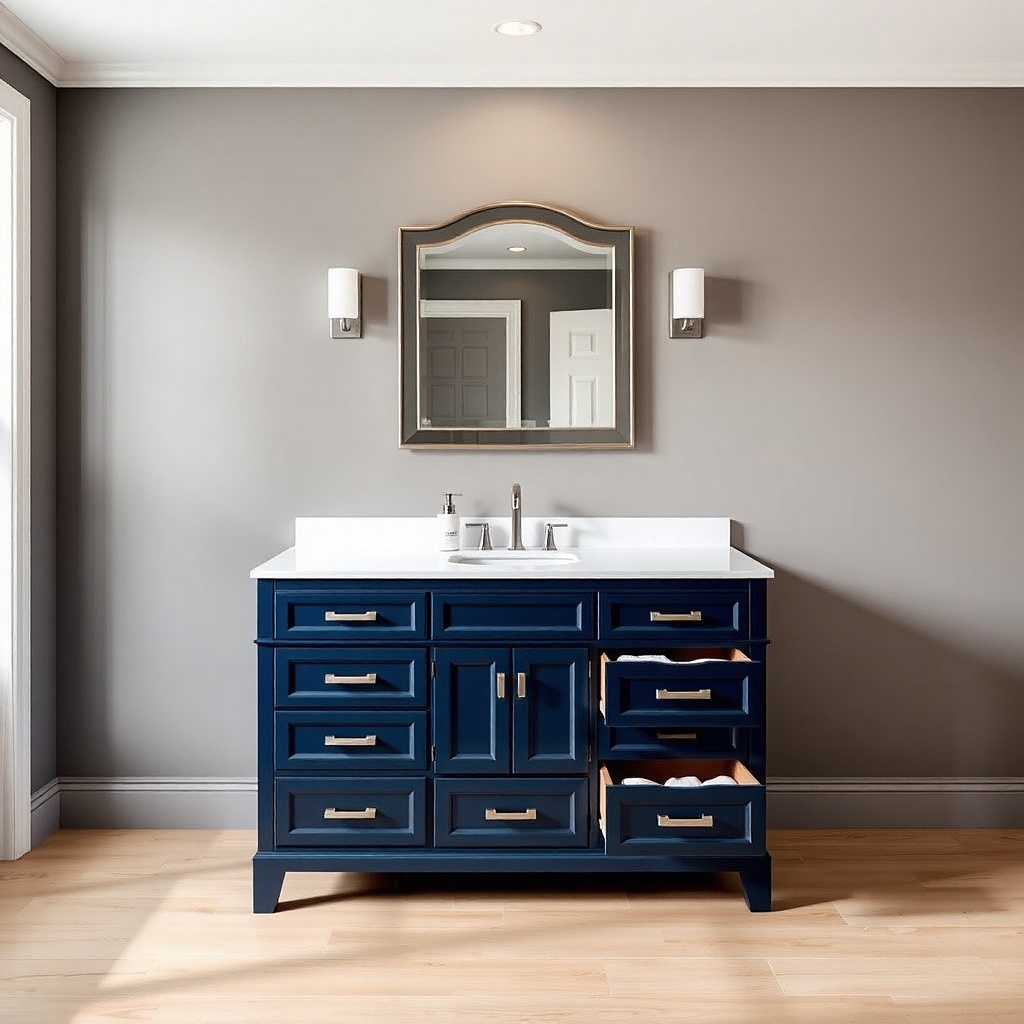
Two-tone keeps the depth feeling intentional instead of one-note. Use a slightly deeper navy on the base drawers and a lighter, more blue-gray navy on the upper cabinet paneling. The eye reads the lighter top as an anchor and the darker drawers as grounded weight, which is why the room feels styled even with simple countertops. Pair it with a bright white or pale warm quartz top and a mirror with a thin frame so the color shift stays clean. This is a strong move in bathrooms where you want navy but don’t want a fully dark front.
Try thisChoose the lighter upper navy to be close to your wall trim color temperature so everything blends smoothly.
Select or custom-order a vanity with separated door/drawer zones, so you can paint or buy the two shades. Use two navy samples and compare them on the bathroom wall under your actual lighting for 10 minutes — undertones shift fast. Install a bright quartz top and keep backsplash simple (a thin strip or none). Add hardware in one consistent metal finish across both tones to avoid a split look.
Common mistakeDon’t add two-tone if your countertop has heavy veining — the pattern will compete with the color shift.
6. Navy slab-front vanity with brushed brass faucet and backlit mirror
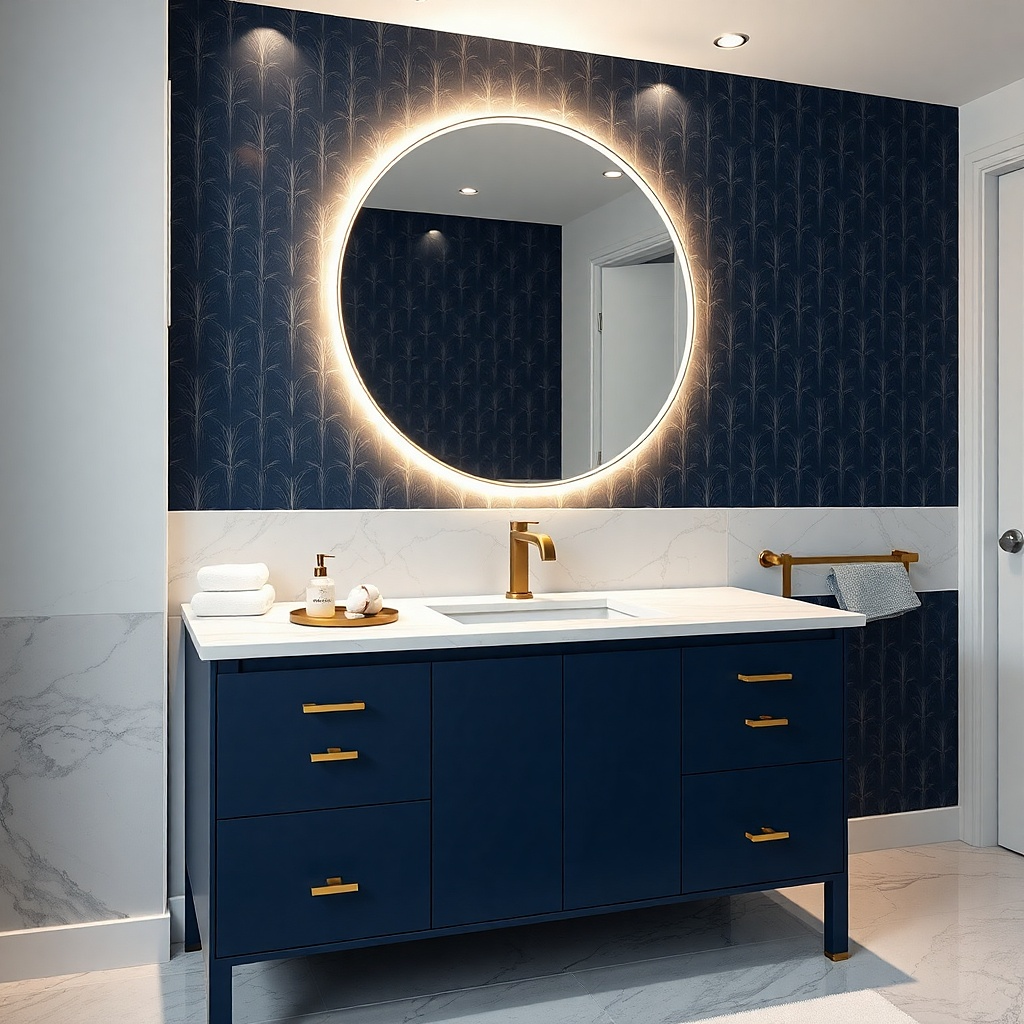
Slab-front navy reads sleek, and the depth comes from uninterrupted planes. When the cabinet face is smooth, the navy looks modern and polished, and the light from a backlit mirror becomes the “depth layer” behind it. A brushed brass faucet and mirror accents add warmth to the navy, so the whole setup feels elegant rather than stark. Use a light countertop to keep contrast high and let the slab front look crisp. This is ideal for powder rooms and contemporary bathrooms where you want a clean, graphic look.
Try thisPick a mirror with a diffused backlight (not a harsh halo) so navy stays smooth-looking.
Choose a slab-front vanity with a flat door face and concealed or minimal hardware. Install a backlit mirror so the light sits behind a thin frame; aim for a mirror height that covers most of the vanity face. Use a light quartz top and keep the backsplash minimal so the slab front stays visually uninterrupted. Match faucet and drain hardware to brushed brass, then set the faucet height so the spout clears the basin comfortably.
Common mistakeAvoid high-contrast black hardware with navy — it makes the slab look busy and less refined.
7. Navy vanity with vertical fluted doors and silver hardware
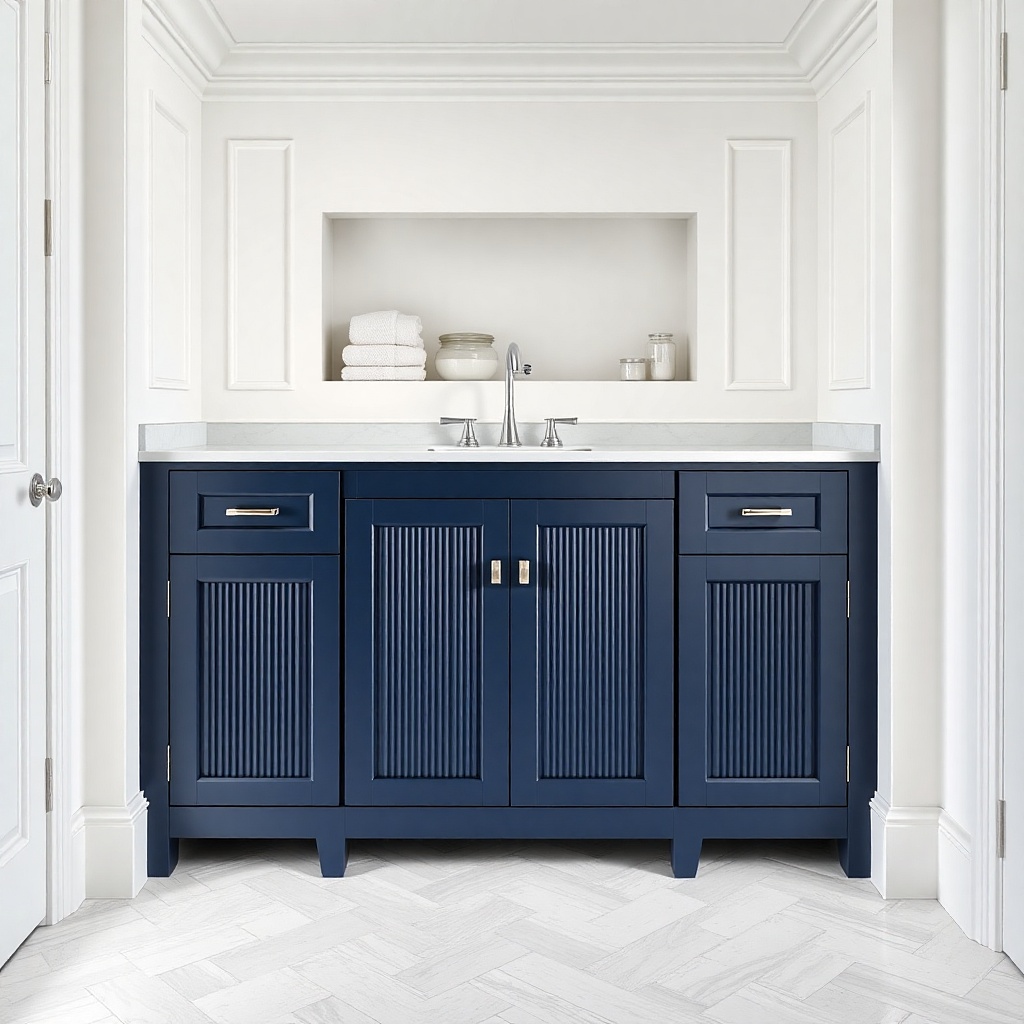
Vertical fluting gives you depth without relying on gloss. The narrow ridges create thin shadows that read like texture, which is why the vanity looks richer in photos and in real life. Keep the finish matte or satin so the flutes look sculpted, not shiny. Silver hardware and a cool-toned countertop keep the palette crisp and modern. This works especially well in bathrooms with neutral walls and light flooring, where texture needs to do the heavy lifting.
Pick a fluted door style where grooves run vertically from top rail to bottom rail; horizontal fluting can fight the bathroom’s height. Choose satin navy to balance texture clarity with everyday durability. Install a light countertop with a simple edge and mount the mirror so it aligns with the fluted section, not the countertop. Use silver-toned pulls sized proportionally to the flutes — medium pulls look best on narrow grooves.
Use a slightly taller mirror than usual; it makes the vertical texture feel deliberate.
Don’t pair fluted navy with a highly patterned backsplash — the grooves already add texture.
8. Navy vanity with an arched top mirror and warm brass accents
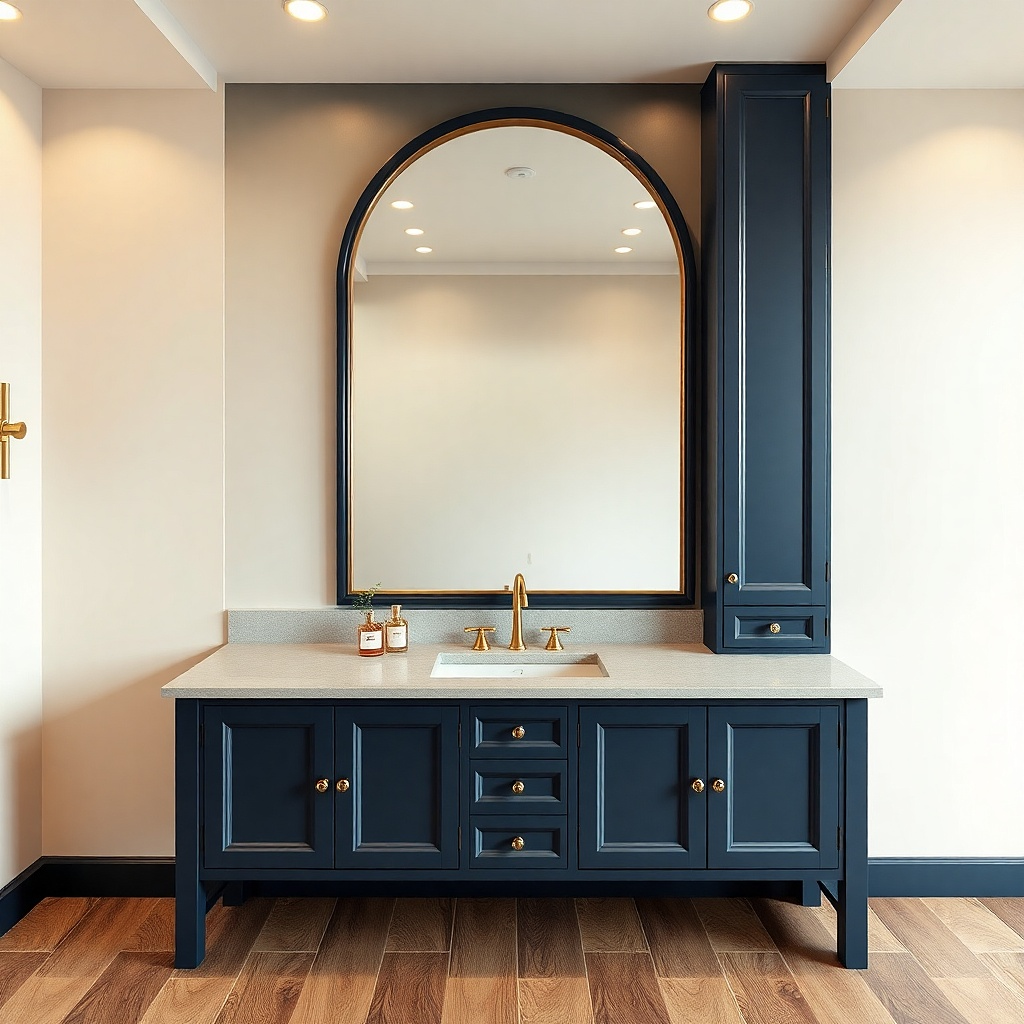
This idea uses shape to create elegance. Navy gives the depth, but the arched mirror adds a softer silhouette that keeps the bathroom from feeling strict. Warm brass hardware works beautifully with navy because it introduces a golden glow that reads luxurious under vanity lights. Choose a white or creamy quartz top so the mirror and brass stand out cleanly. This combo is especially flattering in bathrooms with square tiles and straight lines, because the arch interrupts the geometry in a good way.
Try thisUse warm bulbs at about 3000K if you can; it flatters brass and keeps navy from looking blue-gray.
Select a navy vanity with classic shaker or raised-panel doors so the arched mirror doesn’t clash with a too-modern cabinet face. Install the faucet and hardware first, then center an arched mirror over the sink so the arch sits 2-4 inches above the top edge of the vanity. Use a bright countertop and consider a thin brass backsplash strip if your mirror mounting leaves a visible gap. Match every metal touchpoint — faucet, pulls, and mirror frame — to the same brass finish.
Common mistakeAvoid chrome-only fixtures with warm brass accents — the face will look mixed.
9. Navy vanity with open shelf side and wicker basket storage
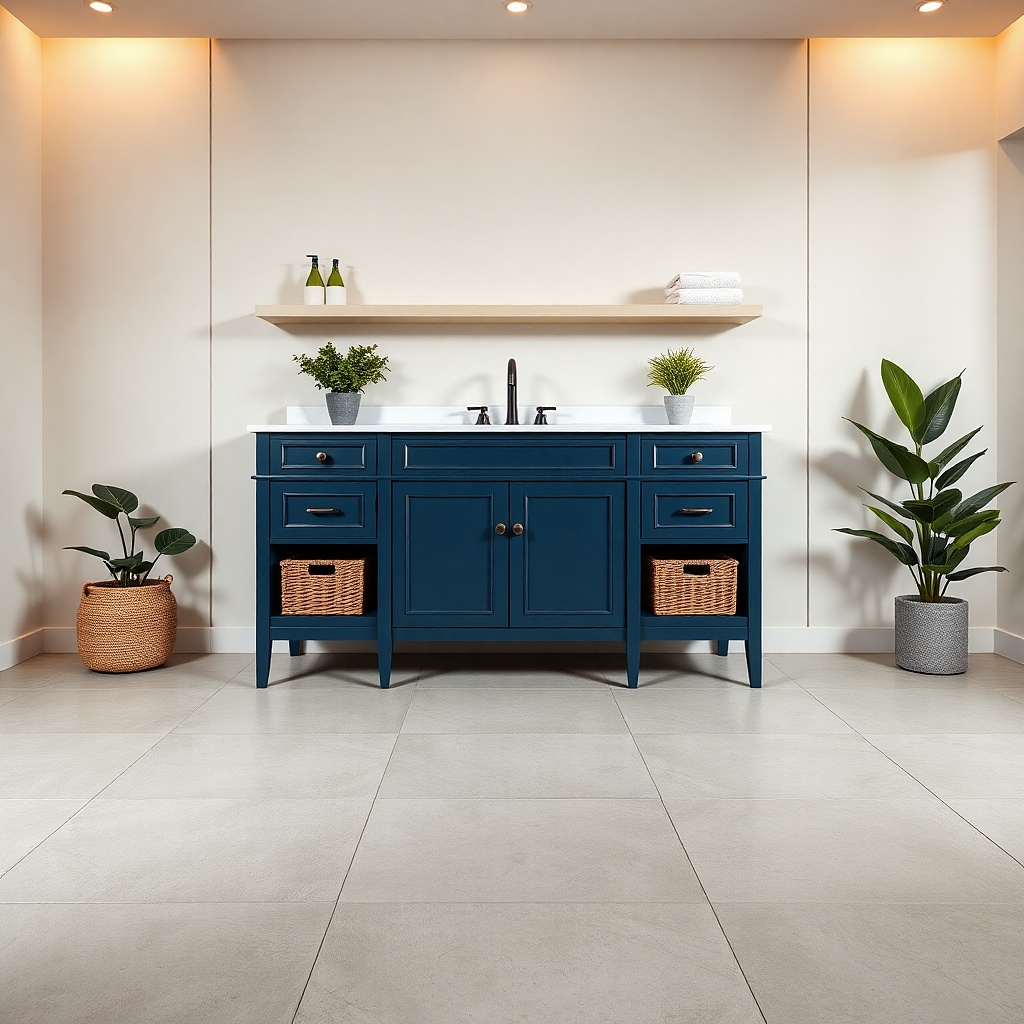
Depth isn’t only color. This layout adds visual layering by giving you an open shelf side in the navy cabinet, then styling it with natural texture. The navy frame makes the shelf look intentional, while wicker adds warmth and keeps the bathroom from feeling too cold. Use a light countertop and keep the mirror simple so the shelf styling stays the secondary focal point. This is a great option for bathrooms that need storage but don’t have room for a tall cabinet.
Try thisKeep only one basket visible at a time; extra baskets can make the navy look cluttered.
Choose a vanity design that includes an open shelf section next to the sink or between drawers. Install the vanity at standard height (32-34 inches to the countertop), then leave shelf space for baskets that fit without touching the door swing. Use baskets in a natural tone (light tan or honey) and keep them uniform in height for a tidy look. Finish with a light quartz top and a mirror that doesn’t compete with the shelf texture.
Common mistakeSkip dark, heavy baskets (black or deep espresso) — they swallow the navy depth and make the shelf look messy.
10. Navy vanity with marble-look veining in light gray and polished chrome
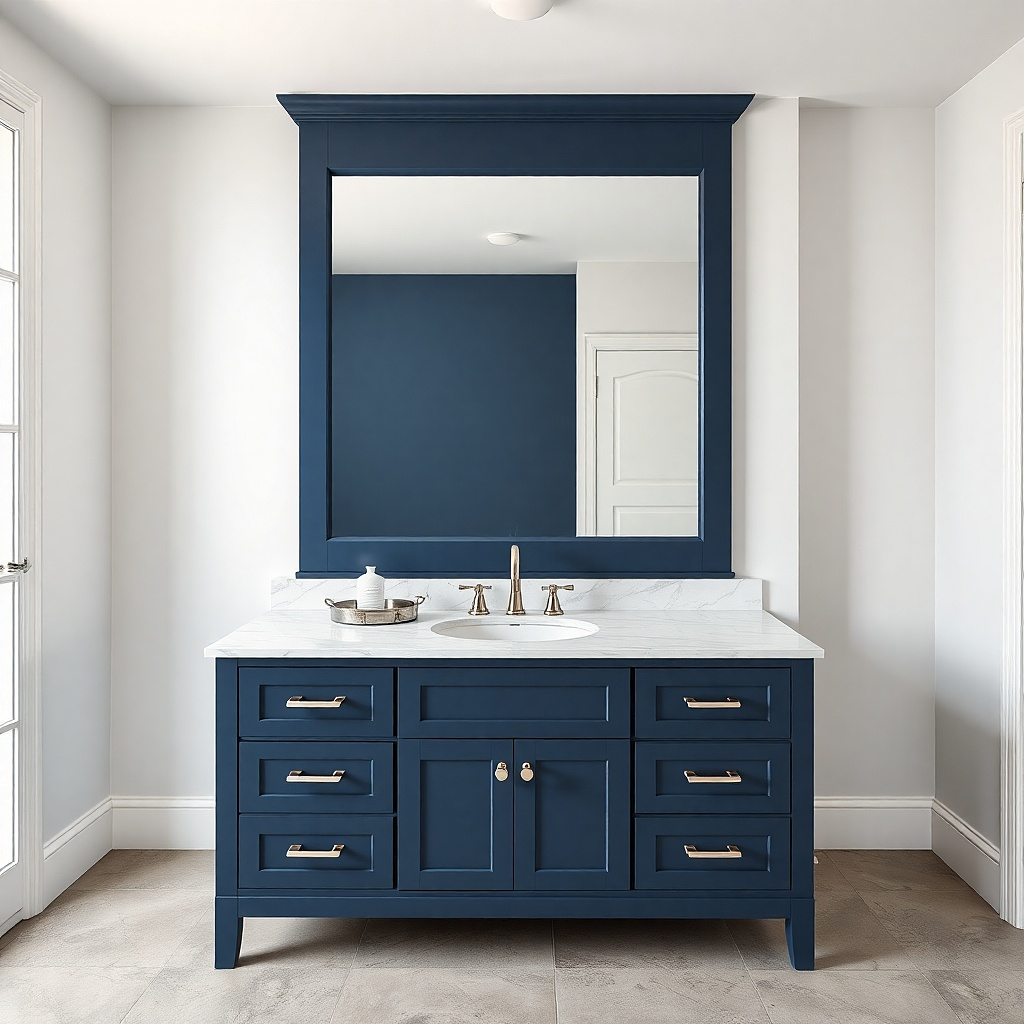
If you want elegance but still like a clean, reflective bathroom, pair navy with a light marble-look top and polished chrome. The navy provides the depth; the marble veining brings movement without going dark. Polished chrome makes the vanity hardware and faucet catch light, which makes the navy feel brighter and more upscale in photos. Use a mirror with a crisp rectangular frame to keep the design sharp. This setup fits bathrooms with gray floors, white walls, and modern lighting.
Choose a countertop that has light gray veining on a near-white base, not a dark base. Install the vanity and faucet, then mount the mirror so it visually aligns with the countertop edge. Use polished chrome pulls and a chrome faucet to keep the palette consistent. Keep the backsplash minimal so the veining remains the only pattern in the center of the wall.
Pick a countertop with medium veining; faint veining reads flat next to navy.
Avoid dark gray veining on a navy vanity — it turns the whole center into one heavy block.
11. Navy vanity with integrated drawer pulls and clean edge detailing
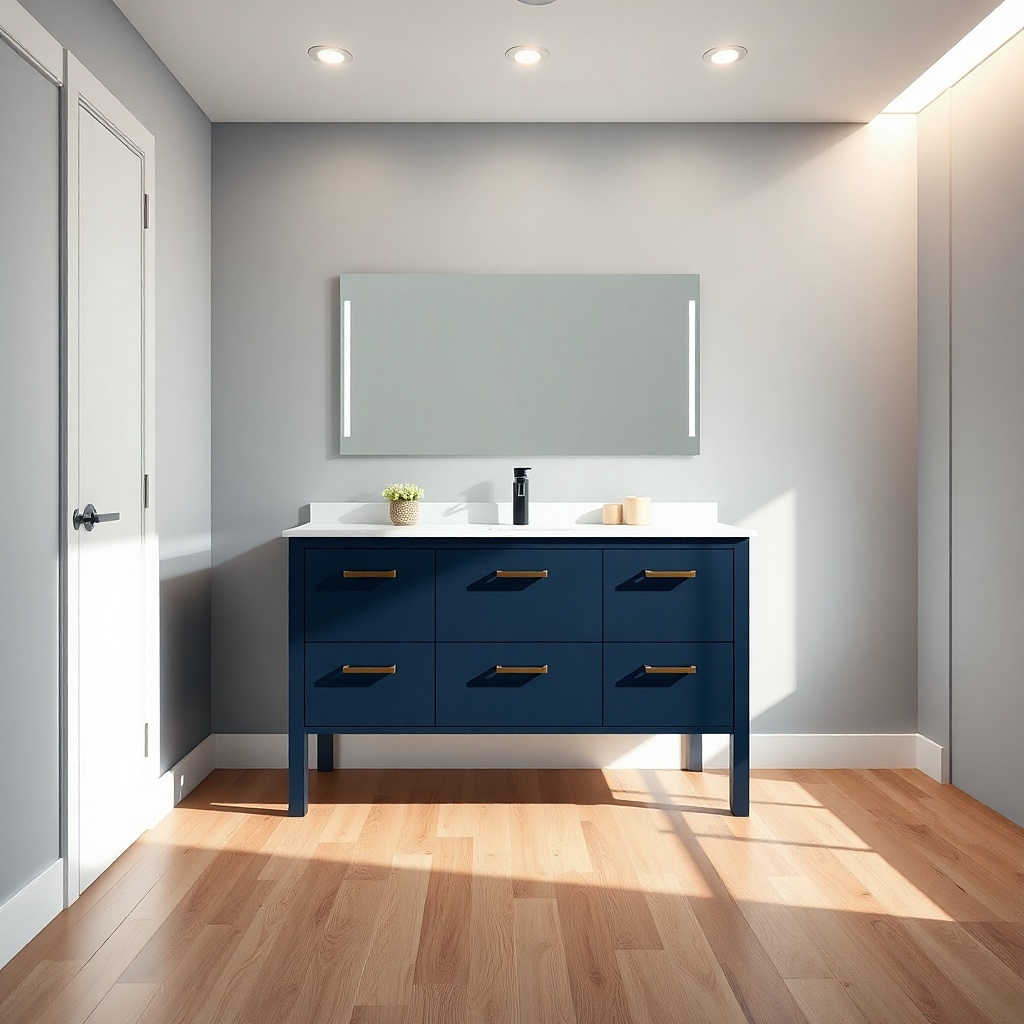
Integrated pulls make the navy face look tailored. When there’s no hardware interrupting the lines, the eye reads the cabinet as one solid plane — and that’s what makes navy feel refined. Pair it with a bright, simple countertop and a round or softly beveled mirror to soften the geometry. This works well if your bathroom has a lot of corners or if your walls are neutral and you want the vanity to be the style anchor. Depth comes from the smooth finish and the crisp edge profile, not from extra decoration.
Try thisUse a thin caulk line where the top meets the cabinet; it makes the whole front look built-in.
Select a vanity design that has finger pulls routed into the drawer fronts. Install it so the drawer fronts sit perfectly level — uneven alignment makes integrated pulls look sloppy fast. Use a white countertop with a straight edge and install a simple backsplash line if needed. Hang a mirror that is wide enough to cover the sink and at least 2 inches of cabinet on each side.
Common mistakeDon’t add decorative hardware to an integrated-pull vanity — it defeats the clean look.
12. Navy vanity with arched toe-kick panel and antique bronze fixtures
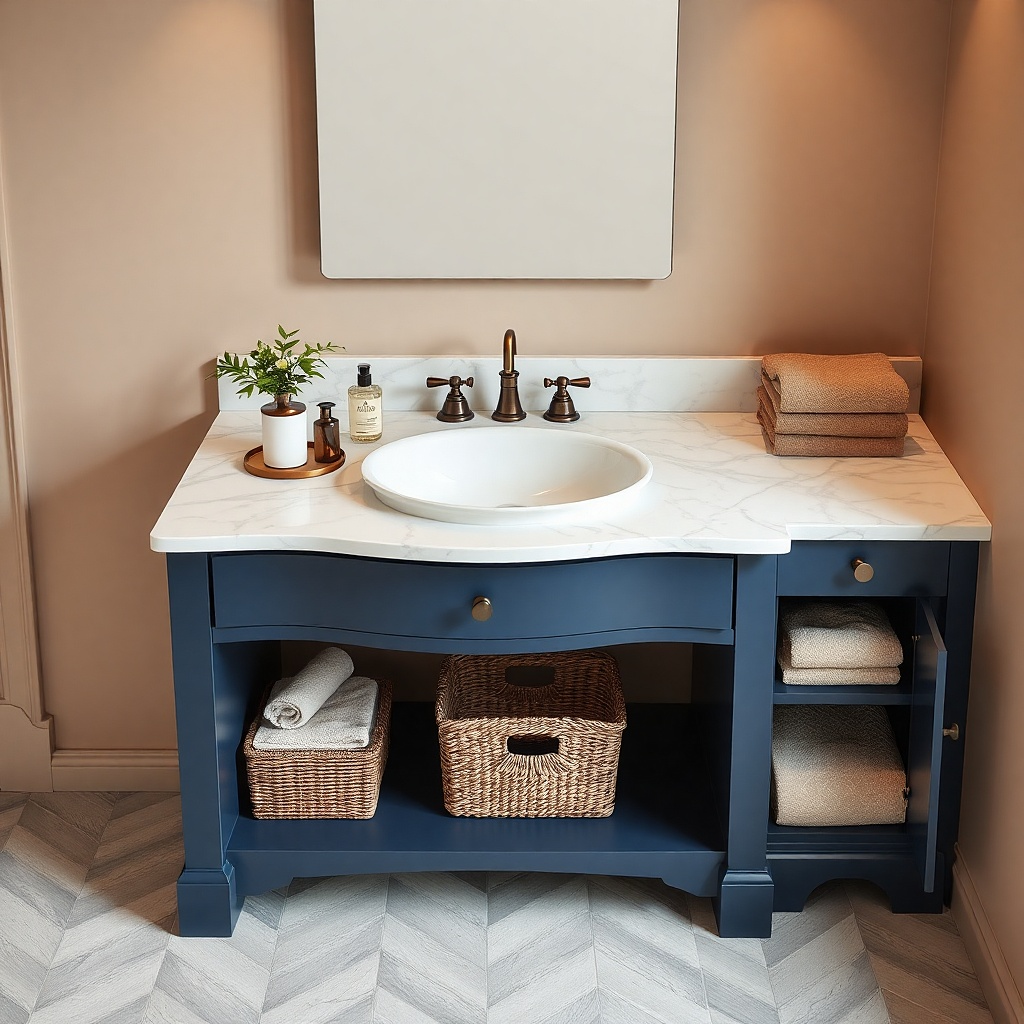
This is traditional depth with a twist. A navy vanity with an arched toe-kick panel gives you a second curved element below, which makes the cabinet feel designed instead of standard. Antique bronze fixtures add warmth and a little patina, so the navy reads more like a deep ink than a flat paint color. Pair it with a warm white countertop and a mirror with a simple frame to keep everything cohesive. This looks great in bathrooms with classic wall molding, subway tile, or patterned floors.
Try thisUse medium-bronze lighting with diffusers so the patina looks intentional, not dull.
Choose a vanity with decorative toe-kick or base panel shaping, not just a plain skirt. Install the vanity first, then set the countertop and faucet so the bronze hardware lines up with the panel curve. Use a warm white quartz top and keep the backsplash tone light so the bronze doesn’t over-darken the center. Select a mirror frame that matches the bronze finish and mount it centered over the sink.
Common mistakeAvoid pairing antique bronze with cool gray countertops — the warmth clash flattens the elegance.
13. Navy corner vanity with a light countertop and round mirror
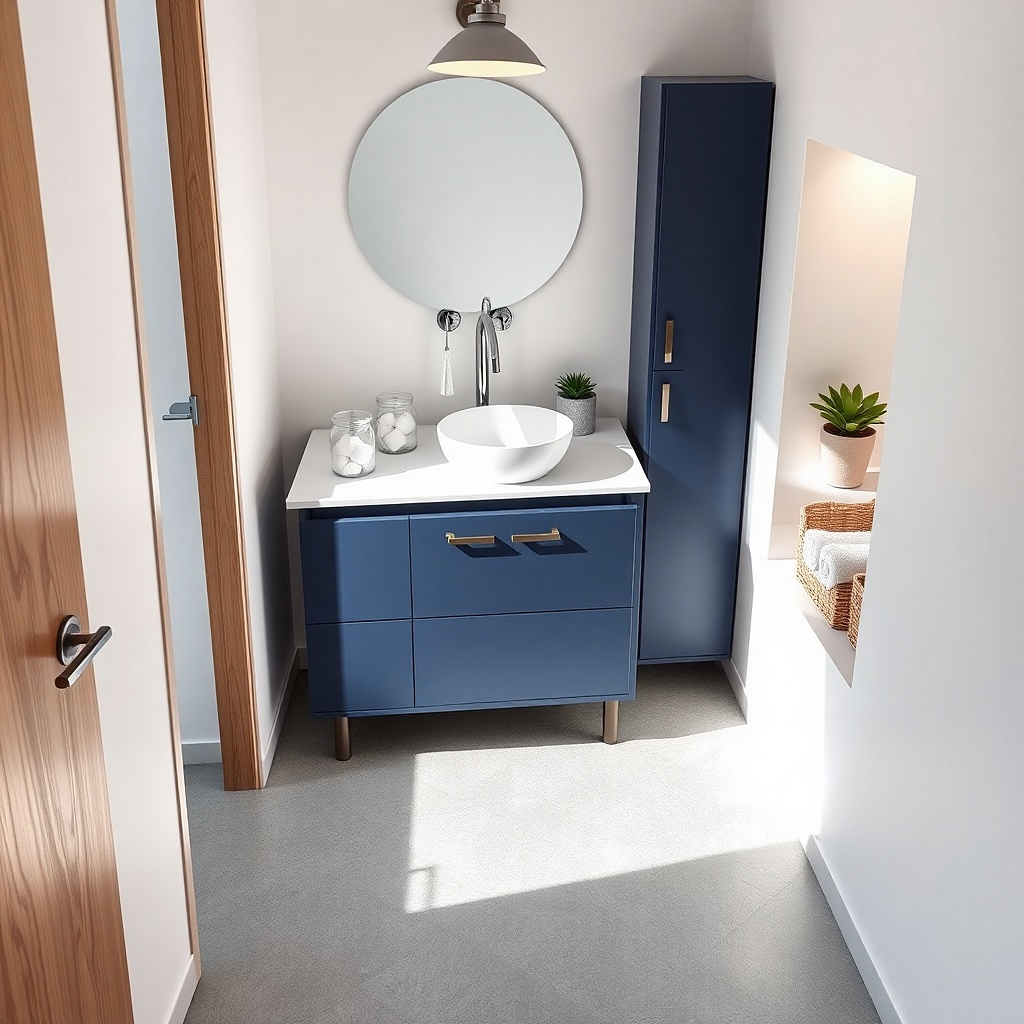
Corner vanities can look awkward. Navy helps by creating a defined focal point in a space that usually feels fragmented, and the depth is visually pulled toward the sink area. Keep the countertop bright and choose a round mirror to soften the corner angles. Hardware in a matching metal finish makes the corner read cohesive instead of two separate pieces. This is ideal for small bathrooms with awkward layouts where the vanity needs to do more than storage — it needs to anchor the room.
Measure the corner wall and pick a vanity with a proper corner footprint so doors and drawers clear the opening. Install the vanity so the countertop edge is level and the sink center lands where you can comfortably use the mirror. Choose a bright quartz top with a clean edge and add a small backsplash if the plumbing requires it. Hang a round mirror centered on the sink so it visually balances the corner.
Use a mirror that slightly overlaps the cabinet edges; it visually “expands” the center even in tight rooms.
Don’t use a tall rectangular mirror that follows the corner angles — it makes the corner look tighter.
14. Navy vanity with peel-and-stick navy backsplash detail behind sink
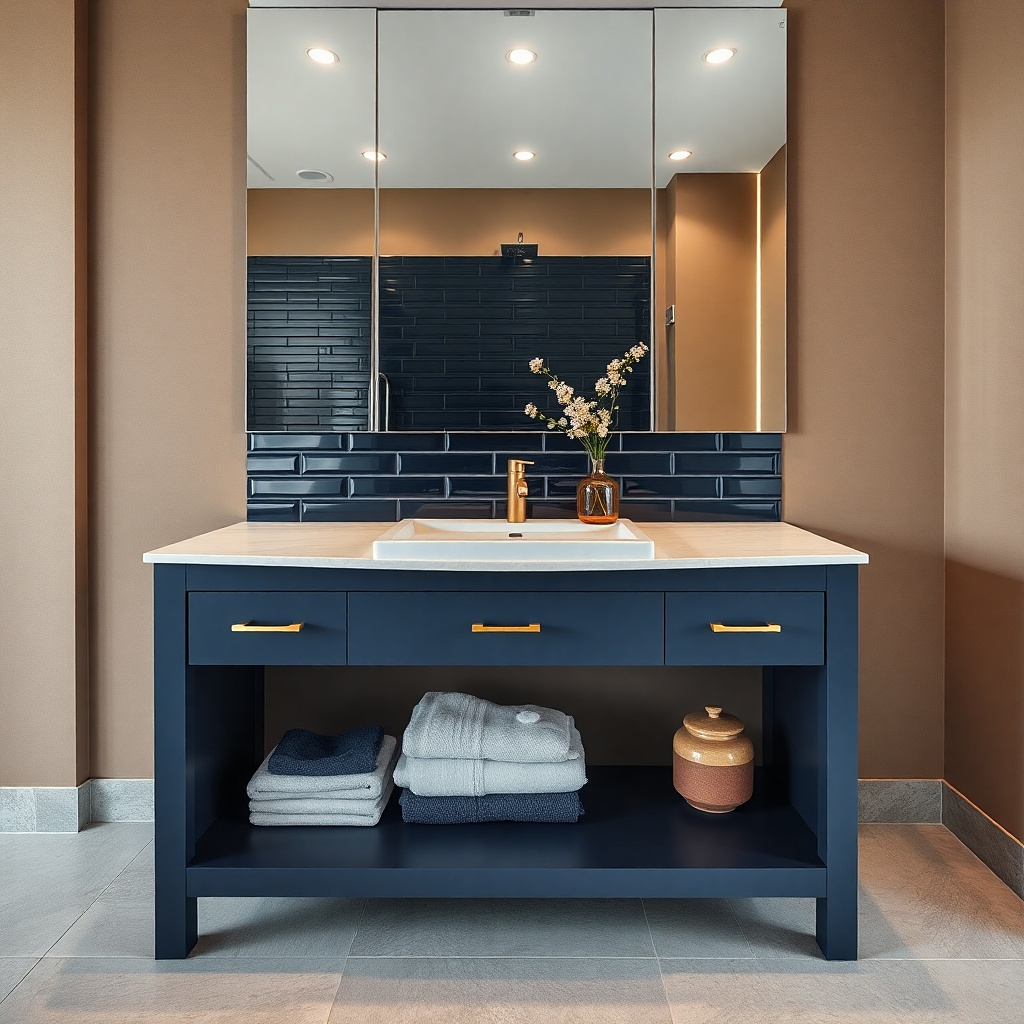
You can get depth without going full navy everywhere. Add a small navy backsplash panel behind the sink and keep the walls otherwise light. The darker zone behind the faucet makes the sink area feel recessed and intentional, which is where “depth” is most noticeable. Use a light countertop and keep the backsplash finish satin so it doesn’t compete with the vanity’s texture. This works especially well if your bathroom has plain white walls and you want a more designed look without retiling the whole space.
Pick a navy backsplash material that matches the vanity undertone and finish (satin tile look or a peel-and-stick panel rated for moisture). Cut the panel to fit behind the faucet and up to the height of the backsplash area you want, usually 16-20 inches. Install the vanity first, then apply the backsplash so it sits tight to the countertop edge. Seal edges around the faucet cutout and grout lines if your material calls for it.
Match the backsplash shade to the vanity door shade, not to the grout color — undertone mismatch is what shows in photos.
Avoid a high-gloss backsplash if your vanity is matte; the shine mismatch reads accidental.
15. Navy vanity with light oak doors inside a navy frame
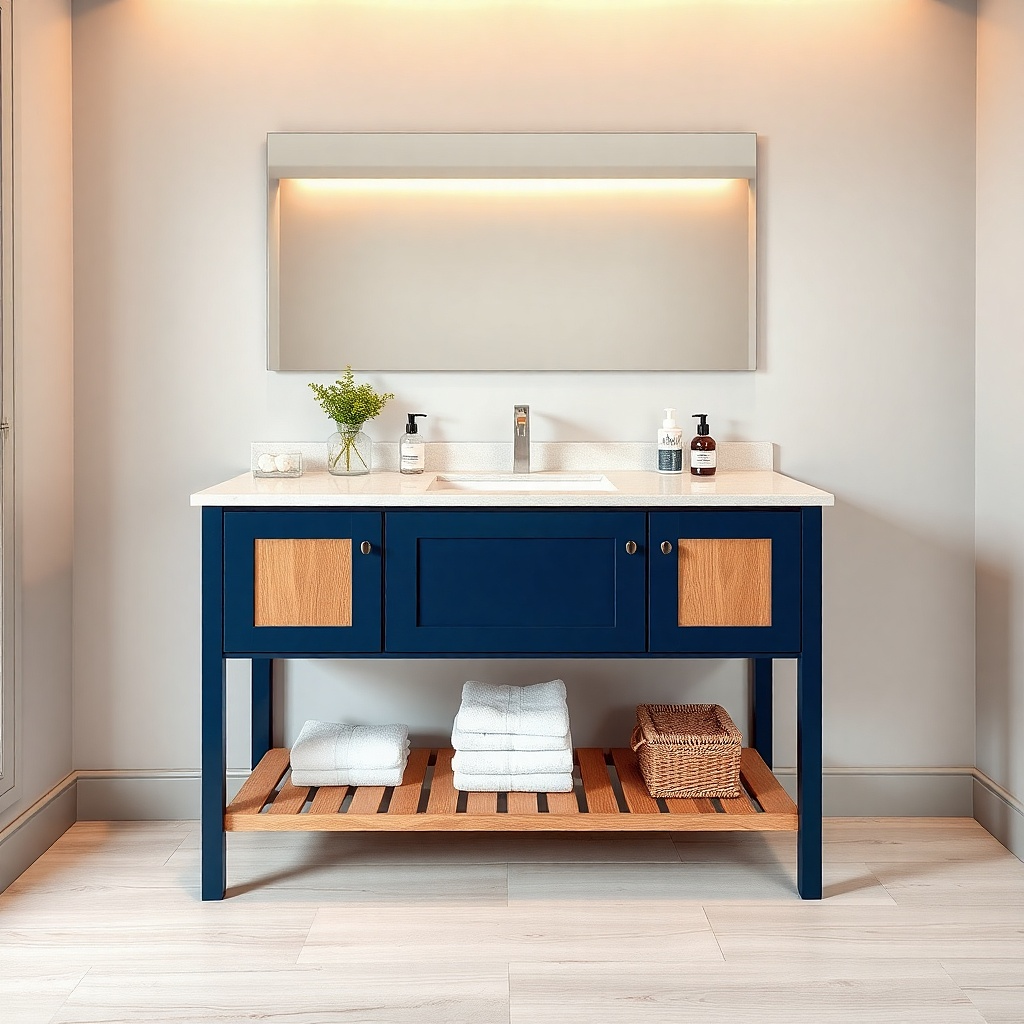
This one brings warmth while keeping the depth from navy. A navy outer frame with light oak interior doors makes the vanity feel dimensional and layered, and it prevents navy from dominating the room. The oak tone adds texture and makes the bathroom feel more livable, especially if your floors are light wood or your shelves are oak. Pair it with a bright countertop and a mirror with a slim natural wood edge or brushed metal. It’s a smart choice when you want depth but your bathroom already has a warm palette.
Try thisUse warm white lighting around 3000K so oak grain looks soft against navy.
Choose a vanity design that separates the outer frame from inner door panels, so you can get the navy frame look. Use a light oak finish with visible grain but matte protection so it doesn’t look plasticky in humidity. Install the vanity, then mount the mirror so it centers over the sink and aligns with the frame width. Pick a faucet finish that matches either the oak warmth (brass) or the room’s other metal (nickel) and keep it consistent.
Common mistakeDon’t pair this with a cool gray stone top — the oak and stone undertones fight.
16. Navy vanity with double sink layout and slim vertical mirrors
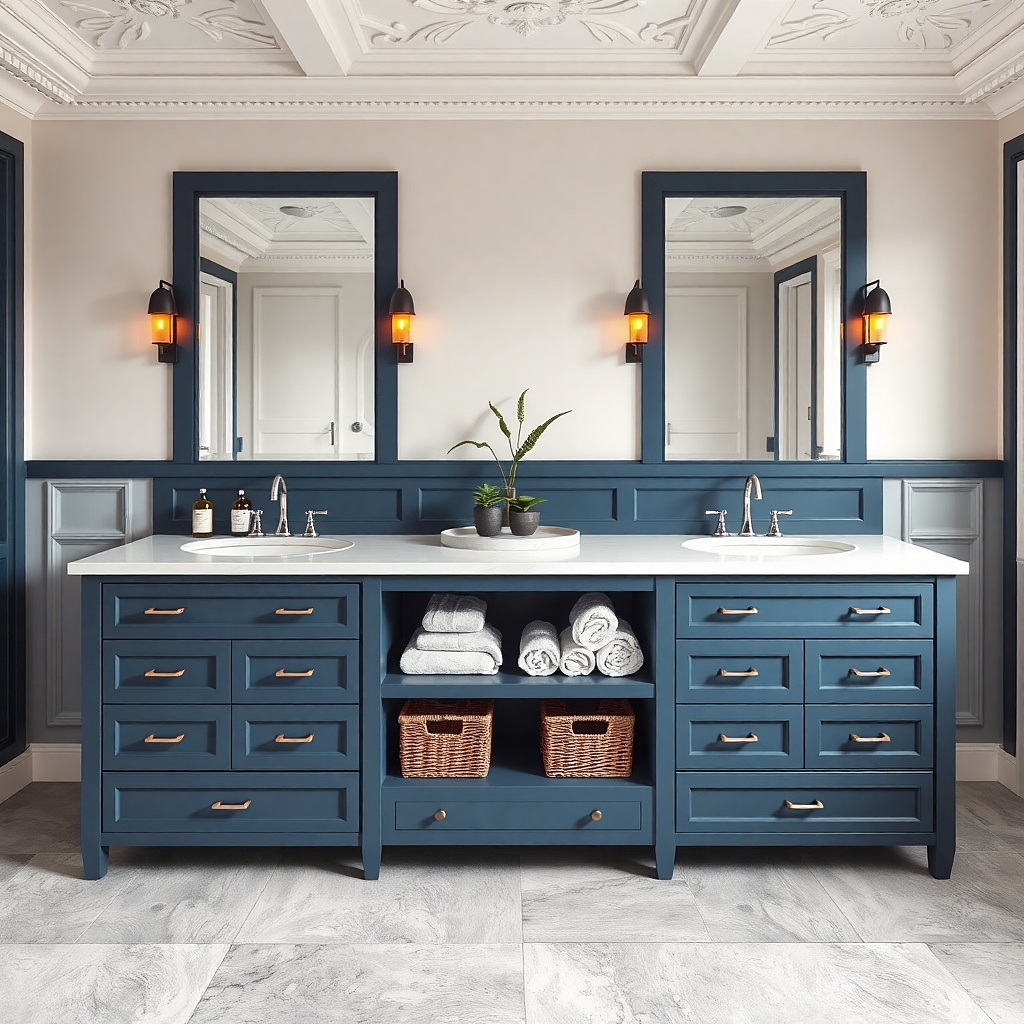
Double sink layouts can feel crowded, and navy can either fix that or make it worse. The trick here is keeping the navy face clean and using slim vertical mirrors that extend upward. Two sinks with matching bright quartz tops keep the center light, while the navy base gives the depth that makes the mirrors and counters look sharper. Choose straight-edged mirrors with thin frames so they don’t visually thicken the vanity. This idea works well in shared bathrooms where the mirror moment needs to look stylish for both people.
Try thisIf you have room, use two identical pendant or vanity lights instead of one central fixture — symmetry makes navy feel more intentional.
Measure the available wall width and pick a vanity size that keeps at least 3 inches between each sink and the vanity edges. Install the vanity centered and level, then set the quartz tops so the front overhang is even. Choose two slim vertical mirrors or one tall mirror that spans both sinks, but keep the frame width under about 1 inch for a refined look. Match hardware finishes across both sinks and keep lighting symmetrical above each mirror.
Common mistakeAvoid thick, ornate mirror frames on double-sink navy; they make the wall look heavy.
17. Navy vanity with textured ceramic tile front panel
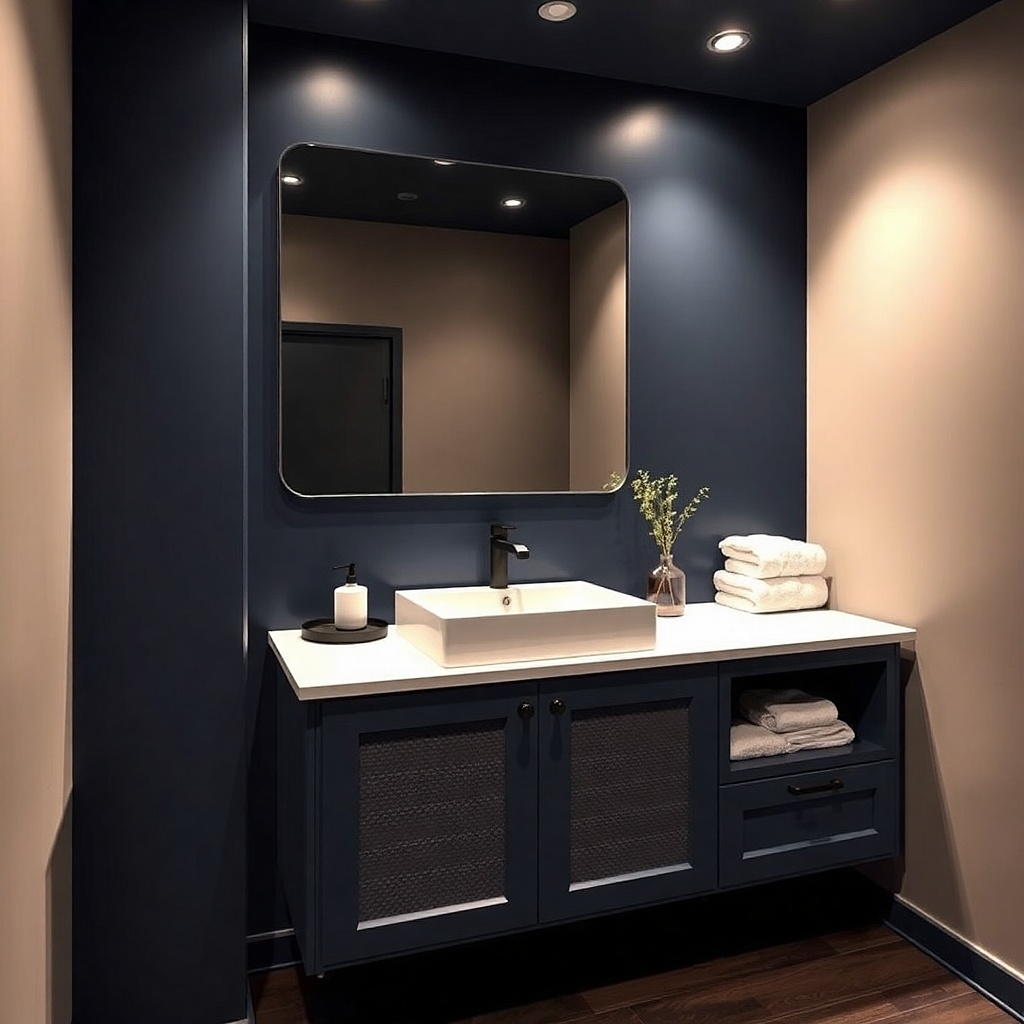
A textured tile front panel adds depth you can see from across the room. The navy base keeps the palette cohesive, while the tile surface catches light differently than paint, creating a layered, handcrafted feel. Use a tile that reads tonal — a navy glaze with subtle variation or a dark navy with gentle speckling — so it doesn’t look busy next to a busy countertop. This is ideal for bathrooms where you want texture without adding more patterns like wallpaper or multiple rugs. The front panel becomes a focal point even if the rest of the bathroom is simple.
Select a vanity with a removable front panel section or choose a custom build that allows tile installation. Install a cement board or waterproof backer where the tile will go, then tile a front panel sized to match the vanity width. Use a grout color close to the navy base (deep navy or charcoal) so grout lines look intentional, not contrasting. Seal the tile and grout, then finish with matching navy paint or frame pieces so the panel sits flush with the cabinet edges.
Use a single tile sheen level (matte glaze works best) so the texture reads premium, not glossy and cheap.
Don’t tile the entire vanity face if you want elegance; cover only a defined front zone so it stays controlled.